Certificate Trust Management

I have recently changed the implementation to verify SSL certificates, which is used for secured FTP, WebDAV and Amazon S3 connections. Cyberduck 3 will honour the trust settings you can configure in Keychain.app and will display the certificate chain that fails validation upon connecting to a server. Previously, a custom dialog was shown which is now replaced by the same standard dialog (which allows editing the trust settings) used in Safari.app or Mail.app.
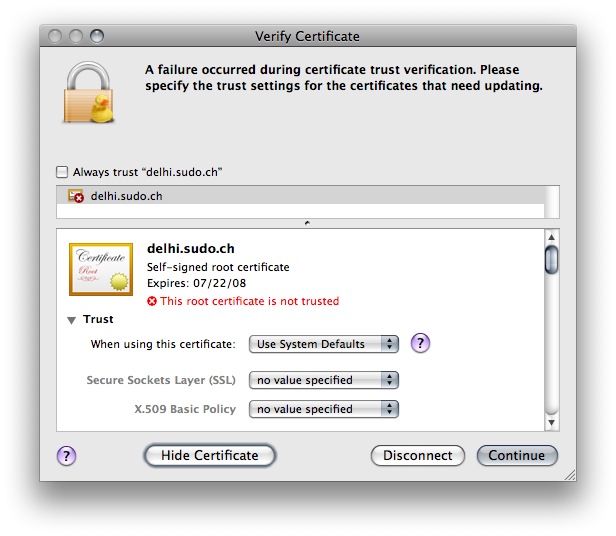
Certificate Trust Setting

Cyberduck 3.0 is expected to be released next month. The current nightly build (use with caution) is available for testing.
Support for WebDAV

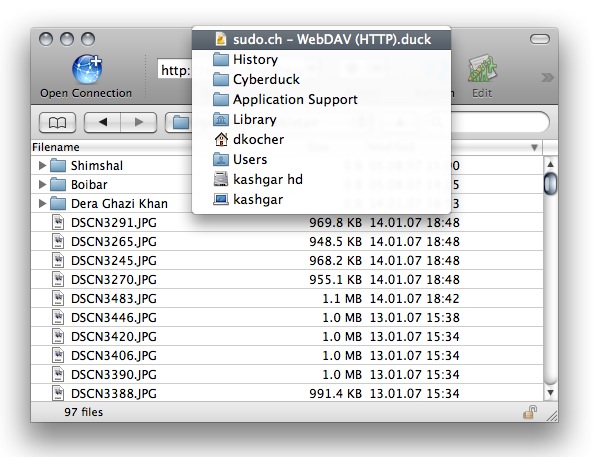
The next major release of Cyberduck will support WebDAV. WebDAV, an acronym for Web-based Distributed Authoring and Versioning, is described as “…a set of extensions to the HTTP protocol which allows users to collaboratively edit and manage files on remote web servers”.

webdav

Although, the Finder.app does support WebDAV, first comparative tests show performance is much better in Cyberduck and browsing feels snappier. Because .mac is based on WebDAV, it will also be possible to access your iDisk using Cyberduck by mounting the URL http://idisk.mac.com/membername as described in this support document.

Cyberduck 3.0 is expected to be released later this next month. The current nightly build (use with caution) is available for testing.
New Bookmark interface

Continuing the series about new features in Cyberduck 3, which started with the Amazon S3 support announcement, I want to highlight a change to the user interface: Since Cyberduck has been available in 2003, it featured a drawer – the new user interface widget introduced with OS X 10.0 – to display the bookmarks. I have decided to change this in Cyberduck 3 and replace it with a ‘inline’ bookmark window as e.g. in Safari.

It features the following improvments:

  • Status. Shows a green bullet if the browser is connected to the remote host.
  • Search. The filter field you are used to in the browser allows to search within the bookmarks, too. It filters the bookmarks with the search string matching either the nickname or hostname.
  • History & Bonjour. A navigation bar at the top allows to select recent connections and to connect to remote hosts discovered via Bonjour/Zeroconf.

Bookmarks

Cyberduck 3.0 is expected to be released later this month. The current nightly build (use with caution) is available for testing.

Support for Amazon S3

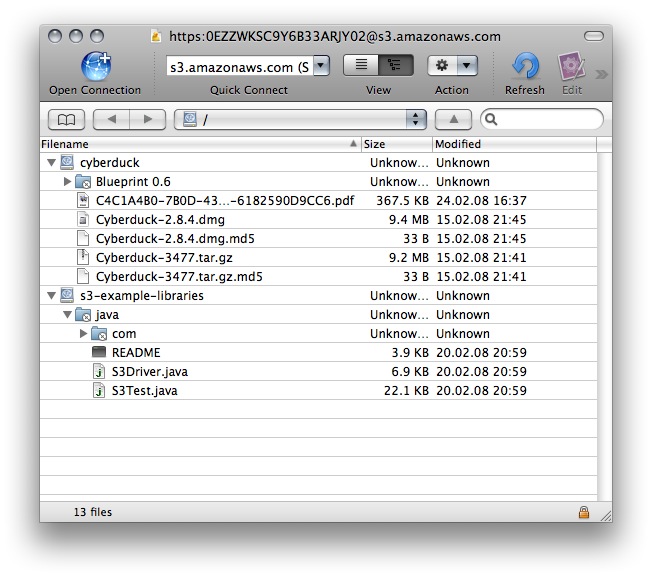
The next major release of Cyberduck will support Amazon S3. I have integrated the excellent open source library JetS3t into Cyberduck. It allows you to transfer files to your S3 account and browse the S3 buckets and files in a hierarchical way as you are used to with other remote file systems supported by Cyberduck.

Amazon S3 Browser

Cyberduck 3.0 is expected to be released later this month. The current nightly build (use with caution) is available for testing.

Nightly builds of upcoming 2.8

Nightly builds of the upcoming 2.8 release are available (r2981). Changes include a new SSH library including the support for SCP transfers, transfer throttling, automatic reconnection on network failures, limiting the number of concurrent transfers and an outline view to browse the folder hierarchy in the overwrite warning and synchronizsation dialogs. Give it a try and report any problems.

Update: The latest build is 3084.

Cyberduck 2.7.3

  • [Bugfix] Problem parsing PASV response from some servers (FTP) #779, #869]
  • [Bugfix] Stalls when connection is interrupted during DNS lookup #960]
  • [Bugfix] Improved sorting in ‘Kind’ browser column #993]
  • [Bugfix] Renaming files using Info panel causes repeated renaming #1005]
  • [Bugfix] Uploading folders interrupts file transfer (SFTP) #1001]
  • [Bugfix] Preference for auto-open delay for spring-loaded folders not saved #633]
  • [Bugfix] Preference to open new browser window on launch not used #997]
  • [Bugfix] Symbolic links on local filesystem not handled properly [#995]
  • [Bugfix] Send creation time of file with UTIME [#–]
  • [Feature] Clear command in History menu [#648]
  • [Feature] Preference to exclude files from transfers using regular expression [#511]

In the news.

Usually Cyberduck is featured in the nowadays popular I use these 10 OS X applications blog entries which thrills me, but this one is different: Elliotte Rusty Harold has written an article published at IBM developerworks titled Java 2007: The year in preview.
First, I had to think of myself when I read of the “(…) satisfied IntelliJ IDEA users will continue to wonder what all the fuss is about [the competition between Netbeans and Eclipse], confident in their belief that it’s the best Java IDE available. (…)” and secondly I was delighted if not proud to see the name of my own little software engineering effort appear in the Client GUIs section which reads “(…) Although many people haven’t noticed, the Java platform has been a real presence on the desktop for four or five years now. More than a few quality desktop applications have been written in Java code, including RSSOwl, Limewire, Azureus, Eclipse, NetBeans, Cyberduck, and others. These applications are written in nearly every GUI toolkit available including Swing, AWT, SWT, and even platform-native toolkits such as Mac OS X’s Cocoa. (…)“. Read the full article here.